In this story
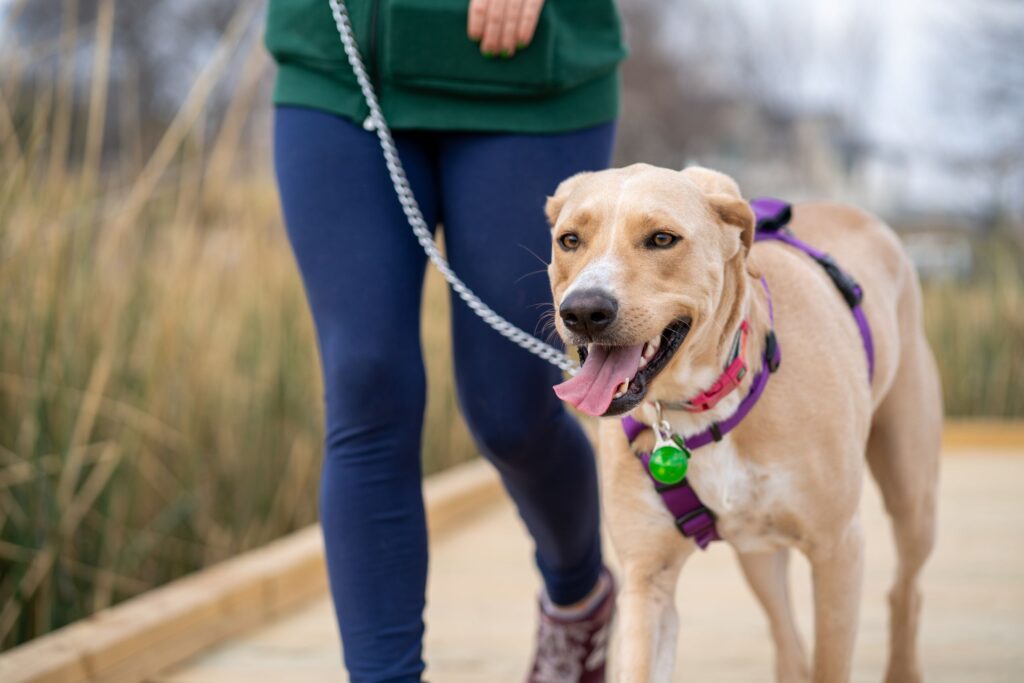
There is a special kind of dread that comes with clipping on the leash and knowing the next twenty minutes will be a tug-of-war. Your shoulder aches, your dog chokes at the end of the leash, and neither of you is enjoying the walk. Here is the reassuring part: loose-leash walking is a trained skill, not a personality trait. The American Kennel Club is blunt about it — puppies are not born knowing how to walk on a leash, and you can start teaching the day you bring your dog home. No dog is too old, too strong, or too stubborn to learn it, but the method matters, and so does your patience.
Why Your Dog Pulls (and Why Pulling Back Does Not Work)
Dogs pull because it works. Every time a tight leash still moves the walk forward, your dog has been paid for pulling — with the thing they wanted most, which is to get to the next smell, the next dog, the next patch of grass. Pulling back only makes it worse: pressure on a dog’s chest or neck triggers the opposition reflex, the instinct to push into pressure rather than away from it. That is why a dog can lean into a collar like a sled dog no matter how hard you hold on.
The fix is to flip the economics of the walk. Make walking beside you the thing that pays, and make pulling the thing that stops the walk. It sounds almost too simple, and it is — but simple is not the same as easy. The method below is the reward-based approach the AKC’s trainers teach, and it works because it is consistent, not because it is forceful.
Get the Gear Right First
Equipment does not train your dog — you do — but the wrong gear makes the job harder than it needs to be. Use a lightweight, fixed-length leash of about six feet. The AKC recommends avoiding retractable leashes for training: they teach your dog that tension moves them forward, which is the exact lesson you are trying to undo. A well-fitted harness is generally the better option for puppies, since it puts no pressure on the neck if they pull, and for a determined puller a front-clip harness can help — the leash attaches at the chest, so pulling gently turns your dog back toward you instead of letting them plow ahead.
Skip the quick fixes. Choke chains, prong collars, and shock collars get results through pain or pressure, and the American Veterinary Society of Animal Behavior’s position is that only reward-based methods should be used for all dog training. Your dog deserves a method that builds trust, not fear — and reward-based walking actually lasts longer, because your dog chooses to stay with you rather than being forced to.
The Step-by-Step Plan
Step 1: Charge your marker. Pick a marker — a clicker, or a word like “yes” — and teach your dog that it means a treat is coming. In a quiet room, click or say the word, then hand over a treat right away. Repeat a handful of times. After a few repetitions your dog will look to you expectantly when they hear it. Only use the marker when you can follow it with a reward.
Step 2: Pay for check-ins. Clip the leash on indoors and mark and reward every time your dog looks at you. You are teaching them that checking in pays, and dogs that check in stay close on walks. As CPDT-KA trainer Michele Miller puts it, engagement is a skill — and it is the foundation of everything that follows.
Step 3: Add a walking cue. Pick a cue like “Let’s go” or “With me” and say it as you start moving, then mark and reward every few steps while your dog stays near you. Treat at your knee or hip, so your dog learns exactly where the paycheque zone is. When you need to turn, say your dog’s name, then a direction word like “Turn” or “Left,” and reward them for staying with you through the turn.
Step 4: Teach the end-of-leash look-back. Sooner or later your dog will reach the end of the leash. When they do, say their name. The moment they look back, mark it, reward them when they come back to you, and start walking again. After several repetitions this check-in becomes automatic — and it builds the same habit as a good recall.
Step 5: When they pull, stop the walk. This is the whole game. The instant the leash goes tight, stop moving. Plant your feet and wait. Your dog will eventually look back at you, take a step toward you, or shift their weight, creating slack. The instant slack appears, mark it and move forward again. Forward motion is the reward, so it only ever happens on a loose leash. Some trainers add a 180-degree turn instead: when the leash tightens, cheerfully turn and walk the other way, rewarding your dog when they catch up beside you. Either way, the rule is absolute — a tight leash never moves you forward.
Step 6: Take it outside, one variable at a time. Once your dog has the idea indoors or in the yard, try a quiet street, then a busier one, then the park. Change only one thing per session — a new location, a new distraction, or a longer walk, never two at once. If the leash tightens repeatedly, drop back a level. Short sessions of five to ten minutes, a few times a day, beat one long weekend marathon every time.
Let Your Dog Sniff
This is the part most owners skip, and it is the part that makes the whole thing work. Sniffing is the point of the walk for your dog — it is how they read the neighbourhood news. Build a “go sniff” release into every walk: say the words, let your dog drift to a patch of grass on a loose leash, and let them investigate. A dog with a legitimate outlet for their nose has far less reason to drag you to one. Think of the walk as a partnership: some of it is your time, walking together, and some of it is theirs. When you call them back with a cheerful “Let’s go!” and reward them for returning to position, you are teaching them that coming back to you is always worth it.
Mistakes That Undo the Training
Walking on when the leash is tight. The single biggest mistake. If you are in a rush and your dog pulls, do not let the walk continue — shorten the outing instead, or just take them out to do their business and come back in. Every tight-leash step forward is a payment for pulling. Jerking the leash or yelling. The AKC is clear that punishment like leash corrections or yelling confuses a dog rather than teaching them. Only paying attention when things go wrong. Most owners only give feedback when the dog pulls. Reward the good walking instead — pay the position, not the fix. Expecting too much too soon. A dog who walks beautifully in your hallway will not walk beautifully past a squirrel on day one. That is normal, not failure. Skipping the treats too early. Once loose-leash walking is reliable in a place, fade the food to every third or fourth good stretch — but keep paying often enough, and unpredictably enough, that your dog never knows when the jackpot is coming.
When to Get Help
If your dog lunges, barks, or panics at other dogs or people on walks, that is reactivity, not ordinary pulling — and it is a different problem that deserves a different plan. A certified professional dog trainer (look for CPDT-KA or a CAAB/ACVB behaviourist) can help, and a puppy class such as the AKC S.T.A.R. Puppy program is a good first step for young dogs. The AKC says a trainer is never a sign of failure: working with one from the start can prevent bad habits from taking root.
Loose-leash walking will not happen in a day, and it will not happen in a week. But one day — probably sooner than you expect — you will realize you have walked three blocks with the leash hanging in a loose J-shape, your dog glancing up at you now and then, and your shoulder feeling perfectly fine. That is the payoff: a walk that belongs to both of you. Start today, in your hallway, with a pocketful of treats and five minutes of your time.
Sources: AKC — “Teach Your Puppy These 5 Basic Cues” (akc.org); AKC — “How to Train a Dog or Puppy to Walk on a Leash” (akc.org); Dogster — “How to Stop a Dog From Pulling While Walking: 8 Vet-Approved Tips” (dogster.com); Asheville Humane Society — “Walking Nicely on Leash” (ashevillehumane.org); American Veterinary Society of Animal Behavior — Position Statement on Humane Dog Training (avsab.org).